Pages

Friday, May 16, 2014

A (Very) Short History of Qatar (Part Four)


Since Independence.


http://www.cosmo-oil.co.jp/eng/press/060406/image/pht.jpgOne of the great keys to Qatari success has been its oil and natural gas production. Experts estimate that the state possesses more than fifteen percent of the world’s proven gas reserves. Because of the petroleum industry, Qatar is one of the wealthiest countries in the world as evidenced by the impressive construction in Doha over the past decade.
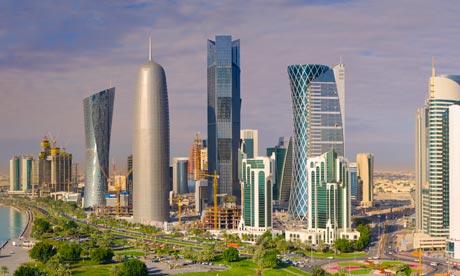
http://static.guim.co.uk/sys-images/Business/Pix/pictures/2012/5/11/1336736498504/Doha-Qatar-008.jpgThe immense wealth balances well with the small population. Just over two million people call Qatar home (permanently or temporarily). Resident foreigners vastly outnumber the Qatari citizenry. Indians and Pakistanis, for instance, constitute the largest ethnic groups with a combined 900,000 residents, while there are only 278,000 Qatari citizens.

The fantastic wealth of Qatar has lead to the erasure of basically all taxes for both citizens and residents, and an all-embracing welfare state for the Qatari people. Even for foreign residents, many services are free or heavily subsidized.

Qatar has also undergone a great deal of political and social change since its inception in 1971. A year after independence, conflict within the ruling al-Thani family resulted in palace coup by which Khalifa bin Hamad al-Thani took power.

Emir of Qatar
Hamad bin Khalifa al-Thani and his wife, Sheikha Moza
The monarchy initiated a program of modernization and modest liberalization after a bloodless second coup in 1995 gained power for Hamad bin Khalifa. That included the establishment, in 1996, of the Al-Jazeera Network through which Qatar is gaining regional influence. As a degree of press freedom has been instituted, the Doha-based satellite television station has attracted a growing audience and become one of the most important broadcasters in the Arab world.

 And testament to the growing influence of the English language in the region, Al-Jazeera launched exclusively English programming in 2006. Legislation approved in 2012, however, maintains certain regulations on what can and cannot be broadcast in media.

Qatar also has the highest level of internet usage in the Middle East, though some material remains filtered.

Additionally, as part of the liberalization efforts, in 1999 Qatar held elections for a municipal council. Women were permitted to both vote and run for office. In 2003, the government established a new constitution (that took effect in 2005) which created a parliament – the Advisory Council – with thirty elected and fifteen appointed members.

Sheikh Tamim (left) and the former emir, Hamad (right)
2003 also saw the beginning of a transition in leadership. That year, Sheikh Hamad announced the preference of one of his younger sons, Prince Tamim, for succession. In 2013, Hamad abdicated and peacefully transferred power – a unique move in the Middle East. Sheikh Tamim had been involved in running the country under his father's direction in previous years, and so many commentators do not anticipate any major changes to foreign or domestic policies of the previous two decades.

The tiny emirate also aims to be a major political player in the region. The Qataris have maintained good relations with the United States for several decades. After Iraq invaded Kuwait in 1990, Qatar allowed American forces on its soil. Qatari troops also took part in the liberation of Kuwait. In 2011, the Qatari helped arm the Libyan opposition and joined international military operations against Muammar Qaddafi.

They have also been active on the diplomatic stage, mediating disputes in the Middle East and Africa. And in 2012, the Afghan opposition was permitted to set up offices in Doha to facilitate peace talks with the American Government.

With so much still in progress, it will be fascinating to watch as Qatar expands its role in the world.


Tuesday, May 13, 2014

A Texan in Dubai

Oddly enough, there are some websites about "Things to Do in Qatar" that actually list "Travel to..." as a top activity.  There's plenty to do and see in Qatar.

At the same time, Doha is becoming a great hub for regional and international travel.  Several major, minor, expensive, and affordable carriers serve Doha International Airport.  Once the new airport is fully operational (it's been in progress for almost ten years now, and only just had a "soft" open for a couple low-cost airlines this last week), the situation will continue to improve.

When I received my Residency Permit the first week of February, I decided to book a trip for the first week of March.  I asked friends and family their suggestions, and the majority voted in favor of Dubai.  I could have chosen a different destination for that trip, because about a month later I went back, this time with a good friend of mine.  As has been mentioned before, here on this site, it's really easy to meet and make friends in Doha -- and it's far better to travel with people.

Dubai is a fantastic place to go.  It's definitely the Middle East's playground.  Whatever you enjoy, they probably have it.

My friend Isaac (who has an interesting, more technical blog, which provides a different perspective on our travels) and I went on FlyDubai, the local low-cost carrier.  I got a round-trip at a nice time for about 600 QR (170 USD); the quality is good; and even if it wasn't, the flight to the Emirates is only about an hour.

Additionally, for Americans, most Europeans, the Persian Gulf state-ers, and some other Westernized peoples, entry into the United Arab Emirates is easy and fast.  In our case, we walked right through the line, they stamped our visas, and we were on our way.

There are plenty of expensive hotels, but through travel sites like Booking, TripAdvisor, and others, high-quality/inexpensive accommodations can be found.  My first trip out I stayed at the Amwaj Rotana just off the beach in the Marina area (great, but a little pricier), and the second at the Flora Grand not far from Dubai International in Al-Rigga (good, and somewhat cheaper -- about $75 a person for two nights).

Travel around Dubai is great as well.  There is an abundance of taxis (the drivers of whom all speak English, or at the very least a version of it); and the Dubai Metro, while mostly a straight shot, stops at almost all the places you want to go, and it's the cheapest ride in town -- 16 AED (about 4 USD) for an all-day pass.

But it's not just about transit and accommodations, is it....There's quite a bit to do and see in Dubai.  Obviously, it depends on your own tastes, but here are a few ideas.

Outside the Madinat Jumeirah Souq
Madinat Jumeirah Souq
The Souq at Madinat Jumeirah was an unplanned but fantastic find.  Our goal was to get as close to the iconic Burj Al-Arab as possible (since one can only go in with a hotel or restaurant reservation, and both are unbelievably expensive).  One the way we ended up at Madinat Jumeirah.  It reminded me a lot of the River Walk in San Antonio.  Pleasant outdoor spaces, places to eat, plenty to buy.  I even found a fairly affordable Medieval Arab helmet -- which I've been looking for since I arrived in the region.

And of course, it's views of the Burj Al-Arab were unbeatable.

Burj Al-Arab
Candid
If you're made of money, there are plenty of places to shop.  Dubai has at least a dozen big-time malls.  The Mall of the Emirates is definitely nice (and you can go snow-skiing there...).  The Dubai Mall is truly the largest shopping center in the world.  It has every store I've ever seen, and a hundred more I've never heard of.  If you're like me and there are only a few stores that sell clothes you can actually wear, and can't find them anywhere in the Middle East, the Dubai Mall has them.

Dubai Aquarium and Underwater Zoo
Dubai Mall Aquarium
And it's not just a mall.  The aquarium is impressive.  It boasts the largest single piece of plexiglass in the world.  The tunnel that goes under the massive tank is a real spectacle.  We ended up spending over an hour wandering through it.  Plus, if you go at the right time, you can watch some divers feed the array of things swimming around in there.

Another part of the facility, up on the second floor, has dozens of smaller tanks with a number of colorful creatures from the beautiful to the bizarre.  And, if you're really taken with the great tank, you can go on a glass-bottom raft ride.  It only lasts ten minutes, but it gives an interesting perspective.
Dubai Aquarium Shark
I pray those needle-teeth never find my leg
Somewhat ridiculously, they give the passengers life-preservers.  We questioned exactly how someone might end up going over the side of the little dingy.  But if it happens to you, don't get eaten.

If you enjoy the more historical aspects of the world around you (like I do), there are a few good sites in Dubai.  There's the old pearl-diving village on Dubai Creek, not far from the former estate of the emir and his family.
Also, an old fort has been transformed into the Dubai Museum (though it was closed when we went -- just a tip, don't go to anything besides the major malls on Friday).  On the other side of the Creek there's a traditional school built in the early 1900s worth seeing, and Heritage House if you want to see how Emiratis lived not too long ago.

There are plenty of other things to do and see, but the cap on the entire trip was a trip up the Burj Khalifa.  For a mere 125 AED (34 USD) it's the best experience for the least amount of money.  It's hard to accurately describe.  Heading in, I thought it would be interesting; but it was better than I imagined.

The ride up to the observation deck is even a spectacle.  You get in a large elevator with LED screens on all sides.  As you go up, the lights run down the walls and the music gets increasingly dramatic.  Then, suddenly, when you reach floor 127, the lights go out and the music crescendos.  Then, the doors open to your first view from "the Top."

The view is spectacular.  We spent two hours wandering about just looking out over the city.  The Dubai Mall and the buildings around it look like models below.  On the northern side of the tower one can see the Emirate of Sharjah on the horizon.  It was late afternoon, so the sun hung low over the coast, which made for a nice scene.  The Palm Islands in the far distance were hazy, but visible, as were the World Islands (still under development).  The Burj Al-Arab, which is itself quite tall, looks miniscule from the Burj Khalifa.  It was easy to stare off in the distance for long moments of time.
Of all the places to go in Dubai, the Burj Khalifa cannot be missed.  But be sure to book your tickets online or you'll miss out -- spots open about a month in advance, and the times fill up faster than you can believe.

So, if you're in Qatar, take advantage of it.


Sunday, May 11, 2014

Return of the Blog

After a series of trips, finals, and other things to occupy time, the Texan's Guide to Qatar will return with new posts this week, discussing things like a trip to Qatari historical sites, some places around Doha to have some fun, bits on travel to Dubai and Egypt (both for surprisingly cheap...from the Doha airport), and maybe even a mention of the new Hamad International Airport.

Sunday, April 13, 2014

A (Very) Short History of Qatar (Part Three)

Oil and Independence.


http://www.qia-qatar.com/sites/default/files/qatar_4.1_gasmap_01.jpgA major step in Qatar’s emergence occurred in 1935 when a consortium of American, British, Dutch, and French oil interests were granted a concession for oil exploration and production in the peninsula. High-quality oil was first discovered at Dukhan in 1939, and additional fields in 1940. Due to the Second World War, production and exportation did not begin until 1949. But over the subsequent decade, oil revenues provided funds for expansion and improvement of Qatar’s infrastructure system. In the 1960s, petrol-based prosperity led to rapid immigration, significant social progress, and the beginnings of modernization.

Decolonization of Europe’s world empires reached the Persian Gulf in 1968 when the British Government announced withdrawal from the region. That same year Qatar entered into negotiations with Abu Dhabi, Ajman, Bahrain, Dubai, Ras al-Khaimah, Sharjah, and Umm al-Qaiwain for the formation of a federation. The plan progressed up to late 1971, when Britain officially terminated its agreements with the Truce States; but the nine states had yet to formalize an agreement on union.

http://si.wsj.net/public/resources/images/OB-VS618_121812_J_20121218143108.jpg
Then, on 3 September 1971, Qatar struck out on a separate course and declared its independence. Bahrain followed soon after. By December of that year the United Arab Emirates was formed, but without those two states as members.

Thursday, April 10, 2014

Exit Permits: Am I Sixteen Again?


For any Westerner over the age of eighteen, it’s taken for granted that once one reaches the age of majority he can pretty much go where he wants when he wants. In a way, that’s not the case in Qatar for a foreign resident. This is an aspect of residency that takes some getting used to, but it’s not as troublesome as it sounds.

Once one has received his Residency Permit and identification card, he can travel but must first ask permission from the government to leave the country. I recently went to Dubai for a weekend vacation. I arranged the trip a month ahead, so I knew exactly when I was leaving well in advance. About two weeks out, I went to the College’s human resources department. As with most everything, the request for and issuance of Exit Permits is managed by the employer. The form was simple: name, Resident ID number, destination, departure date, return date. Two days before my departure, the permit was finalized and human resources gave me a copy of the verification. When I took off, I carried the document with me but no one ever asked for it. The information is tied to the passport, so they have all the records.
 
It’s not as sinister as it sounds. While there is room for problems, it’s minimal. As long as the government receives twenty-four-hour’s notice travel abroad is easy, and in the Persian Gulf region pretty cheap.
 
http://sproutsenroute.com/wp-content/uploads/2011/12/child-at-airport.jpg
So, make sure mommy and daddy know where you’re going and maybe they’ll even let you stay out past your curfew.

Monday, April 7, 2014

Either I'm Famous, or I Look Like Someone Who Is

Despite some (semi-justified) perceptions, people in this region of the world are immensely friendly and generous.  In general, there is always someone willing to help in some way.

The other day, I made the ten-minute walk to the local grocery store for a few things.  I can only buy so much, because the ten-minute walk back with forty-fifty pounds of frozen meat and bottles of water after the first quarter mile.  Waiting in line, an older man started talking, but I didn't realize it was directed at me because he was speaking Arabic.  When it occurred that he was looking at me, I replied "Sorry?" because it could have been that I just misunderstood his English.  "No Araby?" he asked.
"No, sorry, just English," I answered.
"Oh were are you from?"
"The United States."
"Oh yes. Where in United States?"
"Texas."
"I have brother who go to Dallas."

And so our conversation continued.  Then, as the checker was going through my items, the older Lebanese man offered to give me a ride.  Back home, we're taught that's kind of creepy, and not to take rides from strangers.  In local culture, however, it is only polite to make such an offer; and it is highly impolite to not accept (although it's also impolite to automatically accept).  So I told him that was not necessary, but thanked him for the offer.  I was hoping he would not press it, but he did: "No, is okay, so close. I take you."  So I hopped in his truck and we rode to my place.  I hoped out, thanked him, and that was that.  It's how things work here in this part of the world.

Here's something I can't explain:
Just a few weeks after I got here I was at one of the malls, just walking around.  A couple of strangers, Arabs if I remember right, asked to take a picture with me -- not of me, with me.  It's happened a few more times since then, including just the other day.  More interesting, the same happened at the Dubai Mall a couple weeks ago; a group of Indian guys wanted to take their picture with me (three of them, individually).
Some Saudis who recently asked to get a photo with me
I've yet to find an explanation, but I've come up with three possibilities: 1.) people think I'm famous, so they want to get a photo with me (but no one has asked for an autograph so far); 2.) I look like someone famous and so people think I am him (again, no one has asked for an autograph); or 3.) I'm considered fantastically handsome in this part of the world, and people want a record that they saw someone so good looking.
Granted, it's probably not the last or I may have been kicked out of the country (something that has happened, by the way).  But it's probably that one.


Thursday, April 3, 2014

A (Very) Short History of Qatar (Part Two)

The British Period.


While the earliest years of Qatar were dominated by Islamic forces, for about one hundred and fifty years the British were the most powerful influence in Persian Gulf and Qatari affairs.

Due to the Persian Gulf’s proximity to India and other trade interests, the British became highly concerned with stability in eastern Arabia.  To minimize piracy, the United Kingdom arranged the General Maritime Treaty in 1820 with the sheikhs of Abu Dhabi, Ajman, Bahrain, Dubai Sharjah, and Umm Al-Quwain. The British solidified the protectorate status of the “Trucial States” in a subsequent treaty in 1853.
After a series of disputes over territorial claims between Qatar’s tribal elite and the rulers in Bahrain, the two went to war in 1867.  The conflict ended the next year with the semi-independence of Qatar under British protection.  Not only did the English recognize Qatar as a separate entity from Bahrain, but the 1868 Treaty endorsed Sheikh Mohammad bin Thani of Ad-Dawha as ruler of the peninsula.

Despite British dependency status, the Qataris maintained a historic connection with the Ottoman Caliphs.  The Turks held official governance over the Persian Gulf from the 1500s onward.  By the 1800s, that rule was truly indirect with the effective independence of the Treaty Emirates guaranteed by the British.  Still, the al-Thani emirs recognized their subject status to the Ottoman sultans into the early 1900s.  In 1871, Turkish forces established a garrison at the Qataris' invitation.  They would maintain forces in Qatar up until the start of the First World War in 1914.


When the Turks abandoned Qatar to concentrate forces against the Entente forces in 1915, the Ottoman and British governments recognized Abdullah bin Jassim as ruler of Qatar.

With the departure of the Turks, the British negotiated a new treaty with the al-Thani in 1916 and formalized the state’s protectorate status.  Under the agreement with Sheikh Abdullah, Britain gained control of Qatar's external affairs.  The Qataris promised not to cede any territory, or enter into relationships with, any other foreign governments without British consent.  In recompense, the British Government promised protection from all aggression. Another treaty in 1934 provided even greater British protection.  At the same time, British influence inside the country was limited to supervision of some administrative matters.